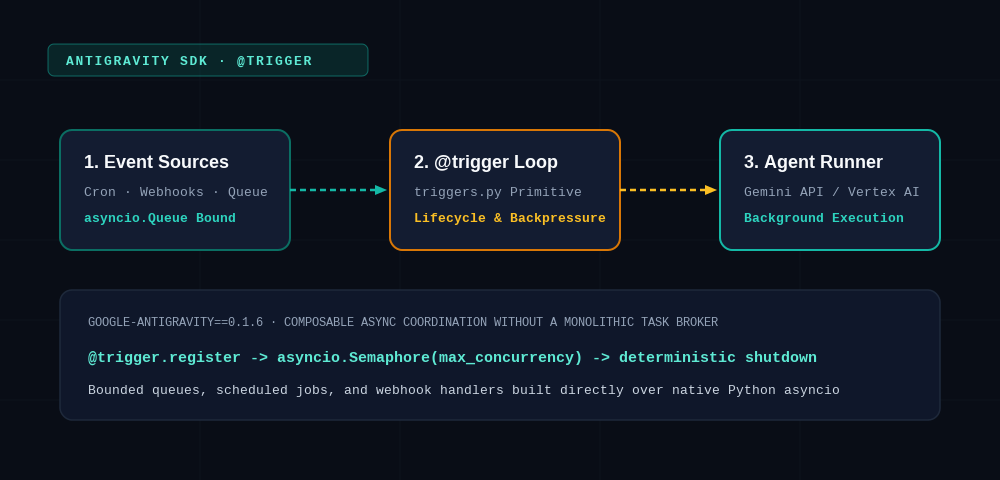
Antigravity Has No Task Queue: Meet @trigger, Its Real Async Primitive
Why the Google Antigravity Python SDK omits a generic task queue and uses Python asyncio with @trigger to compose bounded queues, schedules, and webhooks.
Technical Journal & Publications
Notes on enterprise AI architecture, MLOps, cloud engineering, security, and AI governance, written for engineers and the people who have to sign off on their systems.
Why the Google Antigravity Python SDK omits a generic task queue and uses Python asyncio with @trigger to compose bounded queues, schedules, and webhooks.

Architectural lessons from Vodafone AI Booster on Google Cloud Vertex AI, the platform Google reports cut proof-of-concept to production from about five months to four weeks.

Step-by-step methodology for declarative Vertex AI pipeline deployments with automated policy as code and private VPC peering.
Three books on agentic architecture and development, published under the AINA Press imprint.

What the Exam Tests, and How It Tests It
Exam preparation guide for the Google Cloud Professional Agentic Architect certification. Focuses on architectural judgment calls, scenario distinctions, 240 explained review questions, diagrams, and glossary terms aligned to the October 2026 platform.

From your first prompt to autonomous agents across the desktop, IDE, CLI, and SDK
Practical handbook on running agent-first software engineering across desktop, IDE, CLI, and SDK surfaces with Google Antigravity. Covers review-driven workflows, artifacts, security boundaries, and custom agent plugins.

From Terminal to Agent SDK
A working guide to Claude Code covering the terminal loop, CLAUDE.md conventions, context control, hooks, MCP servers, subagents, and the Agent SDK so agentic coding stays reviewable in production.