AINA · FINOPS DOSSIERFinOps & Architecture12 min read
Token Debt: Why FinOps for Agentic AI Is an Architecture Problem, Not a Model Choice
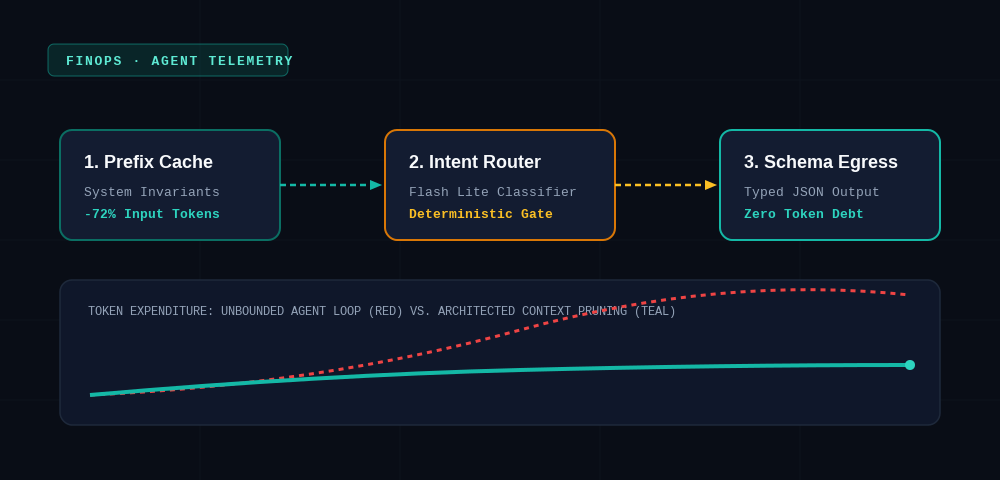

AI cost optimization is often treated as a model selection exercise, but the real savings in agentic systems come from engineering decisions: agent design, context management, orchestration, memory, retrieval, and tool usage.
What Is Token Debt?
Token debt accumulates when subagents loop needlessly, send redundant full file contents, or lack proper context pruning. Over time, unoptimized agent prompts quietly inflate operational expenditure without improving output quality.
Architectural Levers for FinOps
- Context Window Compression: Cache invariant system instructions and prefix prompts using native Gemini context caching.
- Deterministic Routing: Use lightweight classifier models for intent routing before calling reasoning-heavy flagship models.
- Structured Outputs: Enforce JSON schema responses to eliminate conversational verbosity and wasted egress tokens.
Conclusion
FinOps for AI is not about restricting developer experimentation. It is about designing resilient architectural patterns that scale economically.